Building the Future of Airports, Aviation & Aerospace
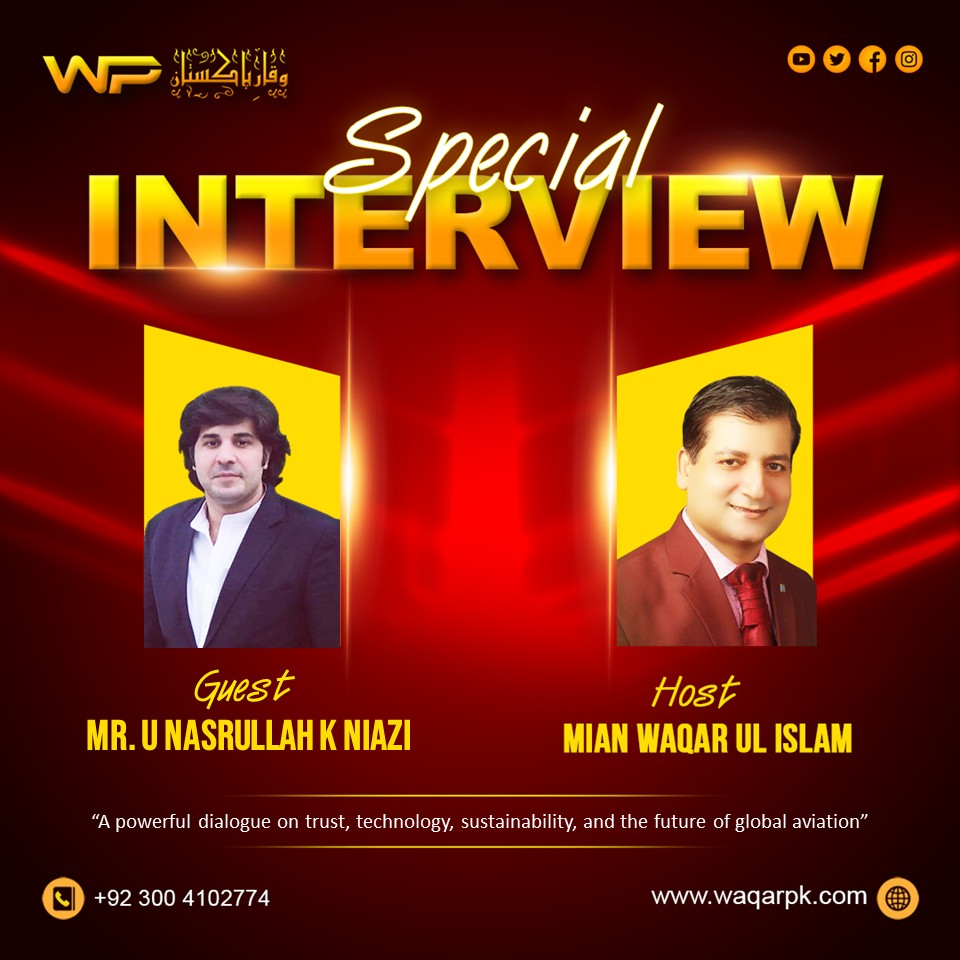
WP Special Interview with Mr. U. Nasrullah K. Niazi
Conducted by Mian Waqar ul Islam
Founder, Waqar-e-Pakistan Literary Research Cloud
Editorial Introduction
For more than five decades, the global Airports, Aviation and Aerospace (AAA) industry has experienced remarkable transformation. From conventional airport operations to artificial intelligence, sustainable aviation, advanced maintenance technologies, digital infrastructure and the growing ambitions of space exploration, the industry continues to redefine the way humanity connects with the world.
Behind every technological breakthrough stands a network of researchers, engineers, innovators and organisations dedicated to creating a safer, smarter and more connected future.
Among these organisations is INAT Group of Companies, a company with roots dating back to 1974. Throughout its history, the organisation has contributed to engineering, inspection, testing, calibration, non-destructive testing (NDT), airport infrastructure, aviation support and international industrial partnerships. Today, through its Airports, Aviation & Aerospace (AAA) division, INAT continues to strengthen relationships with experts, manufacturers, operators and innovators across the world.
During the 2026 Farnborough International Airshow in the United Kingdom, I had the opportunity to speak with Mr. U. Nasrullah K. Niazi, who represented INAT Group of Companies alongside Mr. Mubarak bin Mohammad Al Bajjash, Head of INAT (AAA) in the GCC. Our discussion extended far beyond exhibitions and business opportunities. It became a conversation about knowledge, integrity, technological progress, global cooperation, leadership and the responsibility of leaving a meaningful legacy for future generations.
This interview explores the philosophy behind INAT, the future of aviation, the influence of artificial intelligence, sustainable development, international collaboration and the role that South Asia—particularly Pakistan—can play in the next chapter of global aerospace advancement.
Interview
Q1. Mr. Umer, before discussing the future, let us begin with your roots. Could you introduce INAT Group of Companies and explain the philosophy that has shaped the organisation for more than half a century?
Mr. U. Nasrullah K. Niazi:
Thank you very much, Mr. Waqar. It is a privilege to share our story through Waqar-e-Pakistan Literary Research Cloud.
Every successful organisation begins with values before it begins with products or services. INAT was founded in 1974 by visionary professionals who believed that business should never be built merely to generate revenue. Instead, it should create trust, solve problems and leave behind a legacy that benefits future generations.
From the beginning, our founder established a very simple philosophy:
“Our words are our contract, and our handshake is our signature.”
Those words continue to guide every decision we make today.
The company’s journey has taken us from Houston, Texas, to Columbus, Ohio; from Germany to Finland; from the Gulf region to international aviation hubs across Europe, North America and the Middle East.
Over the years, our scope has expanded to include engineering services, testing, inspection, calibration, non-destructive testing, airport technologies, industrial solutions and strategic partnerships. Yet despite our growth, our priorities have remained unchanged.
Customer service comes before sales.
Integrity comes before profit.
Long-term relationships come before short-term success.
We believe these principles have enabled us to build partnerships that have endured for decades rather than years.
Q2. Many organisations talk about technology. INAT often speaks first about values. Why do you place such importance on character?
Mr. U. Nasrullah K. Niazi:
Technology changes every year.
Character does not.
Artificial intelligence evolves.
Aircraft evolve.
Airport systems evolve.
Business models evolve.
But honesty, patience, respect and integrity never become obsolete.
Our company has worked with professionals from many countries, cultures and industries. Despite these differences, one lesson remains constant: people prefer to work with those they trust.
We therefore encourage our younger generation to invest not only in technical knowledge but also in personal character.
Knowledge can open a door.
Character determines whether people invite you inside.
That is why every partnership we establish begins with mutual respect. Every successful project depends on trust before contracts.
Q3. Your organisation has become increasingly active within the Airports, Aviation and Aerospace community. What inspired this direction?
Mr. U. Nasrullah K. Niazi:
Our connection with aviation did not begin yesterday.
It has evolved through decades of engineering, industrial services and international cooperation.
Airports are among the most sophisticated environments ever created by humanity.
Within one airport, thousands of interconnected systems operate simultaneously.
Passengers experience only a small part of this ecosystem.
Behind the scenes, there are runway lighting systems, baggage handling technologies, navigation aids, communication systems, security infrastructure, aircraft maintenance, calibration, inspection services, logistics networks and countless engineering disciplines working together every minute.
Our team wanted to understand every stage of that journey.
From the moment a passenger enters the airport parking area…
to check-in…
security screening…
boarding…
ground handling…
refuelling…
maintenance…
air traffic support…
and finally the aircraft’s safe departure.
Every stage represents an opportunity for innovation.
That curiosity naturally led us towards the global Airports, Aviation & Aerospace community.
Q4. You regularly attend international exhibitions. Why are exhibitions so important to your organisation?
Mr. U. Nasrullah K. Niazi:
For us, exhibitions are classrooms.
Many people think exhibitions exist only to buy and sell products.
We see something much greater.
They bring together engineers, researchers, manufacturers, airlines, airport authorities, regulators and innovators from every part of the world.
One conversation can introduce an idea that transforms an industry.
One demonstration can inspire years of research.
One partnership can benefit thousands of customers.
Every exhibition allows us to observe technology in action rather than simply reading about it later.
This is why INAT actively participates in international events such as Farnborough International Airshow, MRO Europe, MRO Americas, Aviation Festival, AeroEngines, GSE Expo, Routes World, Aerospace Tech Week and many other global gatherings.
Knowledge grows faster when people meet face to face.
That is something no digital platform can completely replace.
Q5. During the Farnborough International Airshow, what message did you want the global aviation community to hear from INAT?
Mr. U. Nasrullah K. Niazi:
Our message was straightforward.
Today’s world is more interconnected than at any other point in history.
Information travels instantly.
Technology evolves rapidly.
Artificial intelligence is changing every profession.
However, despite all these advances, genuine ideas remain the most valuable resource.
Innovation cannot survive through copying others.
Real progress comes from original thinking.
Our responsibility is not merely to adopt technology.
Our responsibility is to understand it, improve it and apply it responsibly for the benefit of society.
That is the message INAT carries wherever we travel.
We believe the future belongs to those who continue learning every single day.
Q6. Mr. U. Nasrullah K. Niazi, aviation has evolved tremendously over the last few decades. How do you see the industry changing over the next twenty years?
Mr. U. Nasrullah K. Niazi:
We are entering one of the most exciting periods in aviation history.
The next twenty years will not simply introduce faster aircraft or larger airports; they will redefine the entire aviation ecosystem.
Airports are becoming intelligent cities. Artificial intelligence will optimise passenger movement, baggage handling, aircraft scheduling, predictive maintenance and security. Ground operations that once relied heavily on manual processes are increasingly supported by automation, robotics and data analytics.
Sustainability will become a major benchmark for success. Governments, airlines and airport operators are investing in cleaner fuels, carbon reduction strategies, electric ground support equipment and environmentally responsible infrastructure.
At the same time, passenger expectations continue to evolve. Travellers expect speed, convenience, safety and digital experiences from the moment they book a ticket until they reach their destination.
The organisations that succeed will be those that embrace continuous learning rather than resisting change.
Q7. Artificial Intelligence has become the world’s most discussed technology. What role do you believe AI will play in aviation?
Mr. U. Nasrullah K. Niazi:Artificial Intelligence should be viewed as an assistant rather than a replacement for human expertise.
AI can analyse enormous amounts of operational data in seconds. It can identify maintenance trends before failures occur, improve aircraft scheduling, assist engineers during inspections and enhance airport security through intelligent monitoring systems.
Predictive maintenance alone has the potential to save airlines significant operational costs while increasing safety and reducing unnecessary downtime.
However, technology should always support human judgement, not replace it.
The aviation industry operates under extremely high safety standards, and human experience will always remain essential.
Our responsibility is to ensure that AI is implemented ethically, responsibly and transparensively.
Q8. You often mention that INAT studies global research before making business decisions. Why is research so important?
Mr. U. Nasrullah K. Niazi:
Research is our compass.
Without research, decisions become assumptions.
At INAT we constantly study international journals, technical publications, conference presentations, exhibitions and expert discussions. We believe that learning should never stop.
One of our strengths is that we do not rely on a single source of information.
We learn directly from engineers.
We learn from manufacturers.
We learn from airport operators.
We learn from regulators.
We learn from customers.
Every conversation teaches us something new.
Our objective is not simply to understand today’s technology but to anticipate tomorrow’s challenges.
That philosophy allows us to advise our partners with greater confidence and responsibility.
Q9. You have frequently acknowledged aviation journalists and editors. That is unusual for a business leader. Why?
Mr. U. Nasrullah K. Niazi:
Because knowledge deserves recognition.
Behind every technological advancement is someone documenting the journey.
Aviation journalists, editors and researchers perform an essential role by connecting industry professionals with reliable information.
Their reporting helps organisations understand market trends, regulatory developments, engineering innovations and operational challenges.
During international events we always appreciate those who dedicate their careers to informing the aviation community.
Their work encourages learning, discussion and continuous improvement across the industry.
Knowledge is one of the most valuable investments humanity can make.
Q10. Sustainability has become central to aviation. How is INAT responding to this global movement?
Mr. U. Nasrullah K. Niazi:
Every industry now carries a responsibility to reduce its environmental impact.
Aviation is no exception.
We are actively studying developments in Green MRO, sustainable airport infrastructure, energy-efficient ground support equipment and environmentally responsible engineering practices.
Technology continues to evolve rapidly.
Aircraft become more efficient.
Maintenance procedures become more intelligent.
Materials become lighter.
Operations become more sustainable.
Our role is to identify the best available technologies from around the world and introduce them where they create genuine value for our partners and customers.
Sustainability is not merely an environmental objective.
It is a long-term business responsibility.
Q11. Smart airports are becoming a reality. What does the airport of the future look like?
Mr. U. Nasrullah K. Niazi:
The airport of tomorrow will be highly connected.
Passengers will experience faster processing through biometric identification, digital travel documents and intelligent passenger flow management.
Artificial intelligence will coordinate aircraft arrivals, baggage systems, security operations and resource allocation in real time.
Ground support equipment will become increasingly autonomous.
Energy management systems will optimise electricity consumption.
Predictive maintenance will reduce equipment failures before they occur.
Most importantly, every system will communicate with every other system.
That level of integration creates greater efficiency, improved safety and a better passenger experience.
Technology will not replace people.
It will empower people to perform their responsibilities more effectively.
Q12. INAT has extensive experience in Non-Destructive Testing (NDT). Why is this field so important?
Mr. U. Nasrullah K. Niazi:
Non-Destructive Testing is one of aviation’s silent guardians.
Most passengers never see it, yet their safety depends upon it.
NDT allows engineers to inspect aircraft structures and critical components without causing damage.
Techniques such as Ultrasonic Testing (UT), Magnetic Particle Inspection (MPI), Dye Penetrant Inspection (DPI), Radiographic Testing and advanced phased-array technologies enable maintenance teams to identify hidden defects before they become serious problems.
These technologies contribute directly to aviation safety.
At INAT we continue expanding our knowledge and partnerships within the global NDT community because safety has no substitute.
Q13. Space exploration appears frequently in your vision. Why does it matter to INAT?
Mr. U. Nasrullah K. Niazi:
Humanity has always progressed by looking beyond the horizon.
Space exploration is not only about rockets.
It drives innovation in communications, navigation, materials science, robotics, artificial intelligence, manufacturing and countless technologies that eventually improve everyday life.
For us, studying space technologies means investing in future knowledge.
We may not solve tomorrow’s challenges using yesterday’s thinking.
Therefore, we encourage young engineers, researchers and students to dream beyond traditional boundaries.
Every major achievement in history began as someone’s impossible idea.
Q14. What message would you give to young professionals entering the aviation and aerospace industry today?
Mr. U. Nasrullah K. Niazi:
Never stop learning.
Technology changes faster than university textbooks.
Attend exhibitions.
Read research papers.
Listen to experienced professionals.
Ask questions.
Travel whenever possible.
Observe how different countries solve similar problems.
Most importantly, remain humble.
Confidence is valuable.
Arrogance is dangerous.
Success belongs to those who continue learning throughout their entire careers.
Q15. Mr. U. Nasrullah K. Niazi, INAT has been attending international aviation exhibitions for nearly two decades. What makes these exhibitions so valuable?
Mr. U. Nasrullah K. Niazi:
Every exhibition tells the story of where an industry is heading.
When people think of exhibitions, they often imagine product displays and commercial meetings. Those elements are important, but they represent only a fraction of the value.
For us, exhibitions are living universities.
They allow us to meet manufacturers, airport authorities, airlines, regulators, researchers, investors and innovators—all under one roof.
You witness technologies before they become mainstream.
You hear directly from the people designing tomorrow’s solutions.
You understand not only what is changing, but why it is changing.
That knowledge enables us to serve our customers with greater confidence and better long-term planning.
Q16. Which international exhibitions have contributed most to your learning journey?
Mr. U. Nasrullah K. Niazi:
Each exhibition contributes something unique.
Farnborough International Airshow demonstrates the future of aerospace innovation.
MRO Europe and MRO Americas provide invaluable insight into aircraft maintenance, repair and operational excellence.
Routes World helps us understand airport development and route planning.
Aviation Festival showcases digital transformation and passenger experience.
AeroEngines, GSE Expo, Aerospace Tech Week, Global Airport Development (GAD), Inter Airport Europe and numerous regional conferences each contribute specialised knowledge.
Our objective is never to collect brochures.
Our objective is to build relationships.
Knowledge grows through people, not paper.
Q17. Saudi Arabia is investing heavily in aviation. How do you view the Kingdom’s transformation?
Mr. U. Nasrullah K. Niazi:
Saudi Arabia is witnessing one of the most ambitious aviation transformations in modern history.
Vision 2030 is reshaping airports, airlines, logistics, tourism and infrastructure at an unprecedented scale.
Major investments are being made in airport expansion, airline development, cargo operations, smart technologies and international connectivity.
This transformation creates opportunities not only for Saudi Arabia but for the entire Middle East and its international partners.
We believe collaboration between global experts and regional organisations will be essential to achieving these ambitious goals.
Q18. INAT has maintained a strong presence throughout the Gulf region. How important are international partnerships?
Mr. U. Nasrullah K. Niazi:
Partnerships are the foundation of sustainable progress.
No organisation possesses every answer.
Every country develops expertise in different areas.
Germany may lead in one technology.
Japan in another.
The United States in another.
The United Kingdom, France, Finland, Italy and many other nations contribute unique strengths.
Our responsibility is to build bridges between those capabilities.
When organisations share knowledge instead of competing against learning itself, everyone benefits.
Customers receive better solutions.
Industries become stronger.
Innovation accelerates.
That has always been our philosophy.
Q19. Your organisation frequently mentions customer service before commercial success. Why?
Mr. U. Nasrullah K. Niazi:
Because customers remember how you serve them long after they forget the quotation you submitted.
Technology can often be purchased elsewhere.
Trust cannot.
When a customer experiences genuine support, transparent communication and dependable after-sales service, a relationship develops that extends beyond individual projects.
That philosophy has guided INAT since its earliest days.
We never wanted to become simply another supplier.
We wanted to become a long-term partner.
Q20. Many businesses speak about networking. How does INAT define a professional network?
Mr. U. Nasrullah K. Niazi:
Networking is not about collecting business cards.
Networking is about earning respect.
Real relationships develop through honesty, consistency and mutual support.
Over many years we have had the privilege of working alongside engineers, consultants, researchers, airport operators and business leaders from around the world.
These relationships have become an invaluable source of knowledge.
Sometimes a single conversation with an experienced engineer teaches more than weeks of independent research.
That is why we encourage our younger professionals to build meaningful relationships rather than transactional contacts.
Q21. During our earlier discussion, you mentioned several individuals who contributed to INAT’s journey. Why is recognising people so important?
Mr. U. Nasrullah K. Niazi:
No organisation succeeds because of one individual.
Every achievement represents the efforts of many people.
Throughout our history we have been fortunate to work with outstanding professionals from different countries and disciplines.
Some contributed engineering expertise.
Others shared management experience.
Some opened new markets.
Others introduced innovative technologies.
Recognition reflects gratitude.
We believe every person who contributes to a shared mission deserves respect.
Success becomes meaningful only when it is shared.
Q22. Let us talk about Pakistan. What opportunities do you see for the country’s aviation sector?
Mr. U. Nasrullah K. Niazi:
Pakistan possesses remarkable human potential.
Our engineers, technicians and young graduates demonstrate exceptional ability when given opportunities to learn and grow.
The country occupies a strategic geographical position connecting South Asia, Central Asia, the Middle East and beyond.
With continued investment in airport infrastructure, maintenance capabilities, technical education and international collaboration, Pakistan can strengthen its role within the regional aviation ecosystem.
Our future depends not only upon infrastructure but also upon knowledge, research and professional development.
Q23. Earlier you mentioned a new regional focus. Could you explain INAT’s vision for South Asia?
Mr. U. Nasrullah K. Niazi:
Certainly.
For many years our activities have concentrated on the GCC, Europe and North America.
As we move toward 2028, we believe South Asia presents tremendous opportunities for collaboration.
Pakistan, in particular, has an energetic Airports, Aviation & Aerospace community with talented professionals, educational institutions and emerging businesses.
Our objective is to strengthen international engagement by connecting Pakistan’s AAA community with global manufacturers, researchers, airport operators, technology companies and investors.
We envision exhibitions, conferences, technical seminars and collaborative platforms where international expertise meets regional innovation.
Knowledge should never remain confined to one country.
It should travel.
It should inspire.
It should create opportunities for future generations.
Q24. What would success look like for INAT by the year 2028?
Mr. U. Nasrullah K. Niazi:
Success is not measured solely by revenue or expansion.
For us, success means creating lasting value.
By 2028 we hope to strengthen our contribution to the global Airports, Aviation & Aerospace community while expanding collaboration throughout South Asia, particularly Pakistan.
We aspire to help organise international exhibitions and knowledge-sharing initiatives that bring together experts from around the world.
If we can encourage even one young engineer to pursue innovation, one organisation to build a new partnership or one customer to discover a better solution, then we have contributed something meaningful.
That is the kind of success we pursue.
Q25. Mr. U. Nasrullah K. Niazi, after listening to your vision, one question naturally comes to mind: How would you define leadership?
Mr. U. Nasrullah K. Niazi:
Leadership is often misunderstood.
Many people associate leadership with authority, titles or organisational hierarchy. I see it differently.
A true leader serves before expecting to be served.
A leader listens before speaking.
A leader builds people before building projects.
Technology can be purchased. Infrastructure can be developed. Capital can be raised.
But trust must be earned.
Every decision a leader makes should create confidence among employees, customers, partners and society.
Leadership is not measured by how many people follow you.
It is measured by how many people become leaders because you believed in them.
Q26. INAT has introduced internship and personal development programmes. What inspired these initiatives?
Mr. U. Nasrullah K. Niazi:
Every generation inherits knowledge from those who came before them.
We believe it is our responsibility to contribute to that process.
One of our initiatives encourages young professionals to discover the best qualities in other people.
Another teaches that honesty is not a weakness but one of the greatest forms of courage.
Technical knowledge alone does not create exceptional professionals.
Professional ethics, respect, discipline and humility are equally important.
Our objective is to prepare individuals who are not only technically competent but also trusted by society.
Q27. Throughout this interview, you have repeatedly emphasised honesty. Why is this value so central to INAT?
Mr. U. Nasrullah K. Niazi:
Because honesty survives every economic cycle.
Markets rise and fall.
Technology changes.
Industries evolve.
But trust remains timeless.
Without honesty, short-term success may be possible.
Long-term success is not.
Every business eventually reaches a point where customers choose between price and confidence.
Our experience has shown that confidence always creates stronger and longer-lasting relationships.
That is why we continue to remind our teams that our reputation is our greatest asset.
Q28. What advice would you give to entrepreneurs who are beginning their journey today?
Mr. U. Nasrullah K. Niazi:
Begin with purpose rather than profit.
Solve real problems.
Listen carefully to your customers.
Invest continuously in knowledge.
Surround yourself with people who challenge your thinking.
Never stop improving your standards.
Do not compare your beginning with someone else’s success.
Every respected organisation started with a single idea and a small first step.
Persistence creates momentum.
Character sustains it.
Q29. You have spoken frequently about the founder of INAT. What lessons from his life continue to guide the organisation?
Mr. U. Nasrullah K. Niazi:
The founder believed that business should improve people’s lives.
He taught us that respect cannot be purchased.
Integrity cannot be delegated.
Promises must be honoured.
His famous principle—
“Our words are our contract, and our handshake is our signature.”
—remains deeply embedded in our culture.
More than fifty years have passed since the organisation was established, yet these values remain unchanged.
Technology evolves.
Principles endure.
Q30. Artificial Intelligence is transforming almost every profession. What message would you like to share with young innovators working in AI?
Mr. U. Nasrullah K. Niazi:
Artificial Intelligence is one of humanity’s most powerful tools.
But every powerful tool requires responsible hands.
AI should increase human capability rather than diminish human values.
Use AI to discover.
Use AI to learn.
Use AI to solve problems.
Use AI to improve safety, education, healthcare and engineering.
Never allow technology to replace curiosity.
Machines can process information.
Human beings create meaning.
The future belongs to those who combine both.
Q31. Looking towards the future, what is your greatest aspiration for INAT?
Mr. U. Nasrullah K. Niazi:
Our ambition extends beyond commercial growth.
We want INAT to become recognised as a bridge between industries, countries and generations.
We hope future engineers will inherit not only technical knowledge but also a culture of collaboration, integrity and continuous learning.
By strengthening international partnerships and encouraging research, we believe we can contribute to a safer, smarter and more sustainable aviation industry.
Most importantly, we want future generations to feel that they are building upon a strong foundation rather than starting from the beginning.
Q32. Earlier you mentioned South Asia. Could you elaborate on your vision for 2028?
Mr. U. Nasrullah K. Niazi:
Certainly.
By 2028, our strategic focus will extend more actively towards South Asia, with particular emphasis on Pakistan’s Airports, Aviation & Aerospace (AAA) community.
We believe Pakistan possesses talented engineers, entrepreneurs, researchers and educational institutions capable of contributing significantly to the international aviation ecosystem.
Our vision is to facilitate international exhibitions, technical conferences, business forums and knowledge-sharing platforms that connect Pakistan with leading organisations from Europe, North America, the Middle East and Asia.
Through these initiatives, we hope to encourage technology transfer, professional development, research collaboration and long-term partnerships that benefit the entire region.
The future of aviation depends upon cooperation rather than competition alone.
Q33. Finally, what message would you like to leave for the global Airports, Aviation & Aerospace community?
Mr. U. Nasrullah K. Niazi:
My message is one of gratitude and optimism.
Every engineer, researcher, technician, pilot, airport operator, regulator, educator and innovator contributes to an industry that connects humanity.
You make it possible for families to reunite.
You enable global trade.
You support economic development.
You inspire scientific discovery.
Continue learning.
Continue sharing knowledge.
Continue encouraging the next generation.
The future will always present new challenges.
But history has shown that when people work together with honesty, respect and purpose, there is no challenge beyond our ability to overcome.
The sky has never been the limit.
It has always been the beginning.
Interviewer’s Closing Reflections
As our conversation concluded, I found myself reflecting on a simple yet powerful observation.
Throughout this interview, Mr. U. Nasrullah K. Niazi spoke very little about competition and a great deal about collaboration.
He spoke less about products and more about people.
Less about commercial success and more about responsibility.
Perhaps that is why INAT has continued its journey for more than half a century.
The organisation appears to measure success not merely by projects completed, but by relationships built, knowledge shared and values preserved.
In an era increasingly influenced by Artificial Intelligence, automation and rapid technological transformation, one lesson remained constant throughout our discussion:
Technology may define the future.
Character will determine whether that future serves humanity.
As Founder of Waqar-e-Pakistan Literary Research Cloud, I extend my sincere appreciation to Mr. U. Nasrullah K. Niazi for sharing his insights, experiences and aspirations.
I also acknowledge the wider INAT family, its partners, engineers, researchers and colleagues across the world who continue contributing to the advancement of the Airports, Aviation & Aerospace community.
May this conversation encourage future generations to pursue innovation with integrity, leadership with humility and progress with purpose.
About the Interviewer
Mian Waqar ul Islam is the Founder of Waqar-e-Pakistan Literary Research Cloud, an international platform dedicated to documenting the lives, ideas and achievements of distinguished personalities from business, education, science, technology, literature and public service. Through interviews, research publications and editorial features, the platform aims to preserve knowledge, inspire future generations and promote meaningful dialogue across disciplines.
End of Interview