WAQAR-E-PAKISTAN EXCLUSIVE INTERVIEW
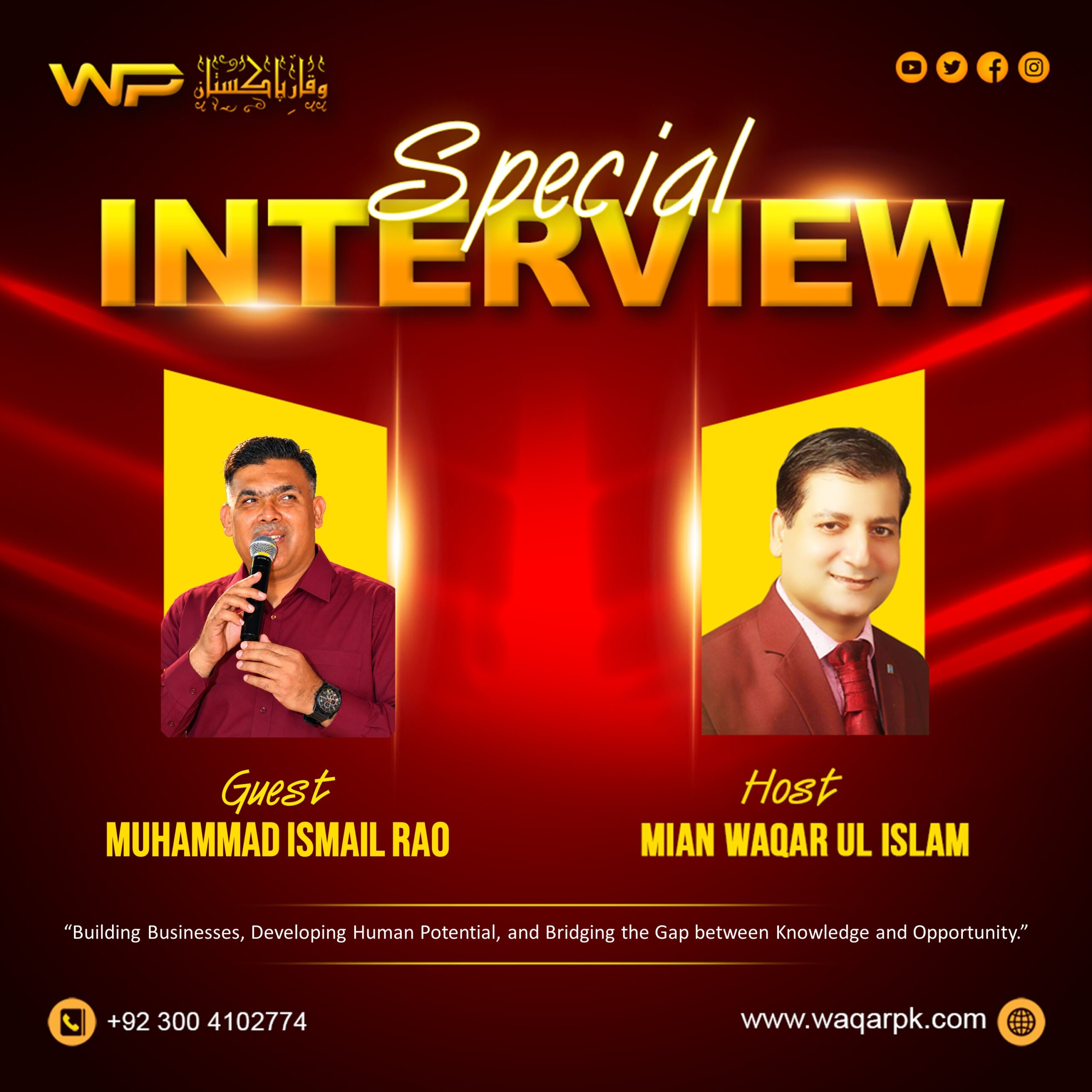
MUHAMMAD ISMAIL RAO: BUILDING BUSINESSES, DEVELOPING HUMAN POTENTIAL, AND BRIDGING THE GAP BETWEEN KNOWLEDGE AND OPPORTUNITY
A conversation on business consultancy, professional education, entrepreneurship, organizational development, digital transformation, and Pakistan’s future
Interviewee: Muhammad Ismail Rao
Chairman, The Professionals
Chief Executive Officer, One Professional
Interviewer: Mian Waqar ul Islam
Founder, Waqar-e-Pakistan Literary Research Cloud
Publication Website: https://www.waqarpk.com/
One Professional: https://www.oneprofessional.net/
The Professionals: https://www.professionals.org.pk/
INTRODUCTION
Economic progress depends on more than capital, infrastructure, or the establishment of new enterprises. It also depends on the quality of management, the competence of the workforce, the ability to adapt to technological change, and the capacity to convert knowledge into productive activity.
For Pakistan, these questions are particularly important. Many aspiring entrepreneurs need guidance in transforming ideas into viable businesses, while established organizations must improve their systems, customer relationships, financial discipline, and market competitiveness. At the same time, students and professionals require practical skills that can translate education into employment, career advancement, and entrepreneurship.
Muhammad Ismail Rao holds leadership positions in two organizations that address different dimensions of this challenge.
As Chairman of The Professionals, he is associated with an institution whose philosophy, “Bridging the Gap,” focuses on connecting knowledge with practical skills, professional capabilities with employment opportunities, and training with organizational growth. Its stated service portfolio includes professional and vocational training, corporate learning, language proficiency preparation, culinary education, and international education consultancy.
As Chief Executive Officer of One Professional, he leads an organization focused on business consultancy, startup development, operational management, customer support, sales assistance, business process outsourcing, digital marketing, website and software development, and business automation.
These organizations have separate identities and purposes, but their areas of work raise a common question: how can professional knowledge, effective systems, and appropriate technology be combined to create lasting value?
In this exclusive interview, Mian Waqar ul Islam, Founder of Waqar-e-Pakistan Literary Research Cloud, explores Muhammad Ismail Rao’s organizational vision, leadership philosophy, approach to business development, views on Pakistan’s skills gap, and perspective on the role of artificial intelligence and digital transformation.
PART I: LEADERSHIP AND THE PHILOSOPHY OF TWO ORGANIZATIONS
Question 1: You lead two organizations working in different fields: The Professionals and One Professional. What is the central idea connecting your professional vision?
Muhammad Ismail Rao — Proposed Editorial Response:
The central idea is to help people and organizations become more capable of achieving their objectives.
The Professionals approaches this through education, training, practical skills, and professional development. One Professional approaches it through business consultancy, operational support, customer engagement, sales assistance, and digital solutions.
These are different areas of work, and each organization must maintain its own identity and standards. However, both recognize that sustainable progress requires more than good intentions. It requires relevant knowledge, effective implementation, professional discipline, and a willingness to improve continuously.
Whether the objective is to prepare an individual for a career or help a business establish more effective operations, the underlying principle is to connect potential with practical achievement.
Question 2: Why is it important to distinguish between professional education and business consultancy while recognizing their complementary roles?
Muhammad Ismail Rao — Proposed Editorial Response:
Professional education and business consultancy address different problems.
Education and training focus on developing knowledge, skills, and professional capabilities. Business consultancy examines an organization’s objectives, structure, processes, resources, and challenges, then helps identify appropriate ways forward.
A business may employ qualified people but still struggle because responsibilities are unclear, financial controls are weak, customer inquiries are poorly managed, or decisions are not supported by reliable information. Conversely, an individual may have a clear entrepreneurial ambition but lack the practical skills needed to implement it.
The two fields therefore complement each other without becoming interchangeable. Education develops people’s capabilities, while consultancy helps organizations establish the conditions in which those capabilities can be used effectively.
Question 3: Your organizations emphasize trust, accountability, practical value, and long-term relationships. How can these principles be maintained in a competitive commercial environment?
Muhammad Ismail Rao — Proposed Editorial Response:
Competition should encourage organizations to improve their services rather than abandon their principles.
Trust is established through honest communication, realistic commitments, clear responsibilities, and dependable delivery. Accountability means accepting responsibility for the work undertaken and being willing to discuss shortcomings when expectations are not met.
Long-term relationships also require organizations to understand that clients have different requirements, resources, and priorities. A suitable solution for one business may not be appropriate for another.
Professionalism is therefore not simply a matter of presentation. It must be reflected in how an organization understands requirements, defines the scope of work, communicates progress, manages expectations, and evaluates results.
PART II: ONE PROFESSIONAL — FROM BUSINESS IDEAS TO SUSTAINABLE ENTERPRISES
Question 4: One Professional describes its approach through the principle “One Destiny for Your Business.” What does this mean in practical terms?
Muhammad Ismail Rao — Proposed Editorial Response:
The principle reflects an approach in which business support is organized around the client’s objectives rather than around an isolated service.
An entrepreneur may initially require feasibility analysis and business planning. As the enterprise develops, the priorities may shift toward operational management, human resources, customer communication, sales development, or digital systems.
The purpose of an integrated service portfolio is to help clients identify the support they actually need at each stage of their business journey.
This does not mean that every client requires every service. The appropriate approach begins with understanding the business, identifying its priorities, and selecting services that are relevant to its circumstances and resources.
Question 5: Many aspiring entrepreneurs in Pakistan begin with an idea but lack a structured plan. How should they approach the process of establishing a business?
Muhammad Ismail Rao — Proposed Editorial Response:
A business idea should first be examined as a proposition that must work in a real market.
The entrepreneur needs to understand the customer problem, identify the intended market, examine competing offerings, estimate the cost of delivery, and determine whether customers are willing to pay a sustainable price.
A feasibility study can help assess the commercial assumptions. A business plan can then translate the findings into an operating model, financial projections, resource requirements, and an implementation strategy.
Company registration, incorporation, and other legal requirements should be addressed according to the business structure and applicable regulations. Operational planning must also consider responsibilities, suppliers, customer acquisition, and the resources needed to begin trading.
The sequence is important because formal registration alone does not establish commercial viability. A properly structured business must have a credible reason to exist, a realistic way to operate, and a path toward financial sustainability.
Question 6: One Professional includes feasibility studies, market research, competitor analysis, and financial projections among its services. Why do entrepreneurs sometimes underestimate these activities?
Muhammad Ismail Rao — Proposed Editorial Response:
Entrepreneurs are often motivated by the possibilities they see in an idea. That enthusiasm is valuable, but it can lead them to focus on the expected benefits without examining the assumptions on which the business depends.
Market research helps establish who the potential customers are and what alternatives they already have. Competitor analysis provides a clearer understanding of pricing, positioning, and differentiation. Feasibility analysis examines whether the proposed model is realistic, while financial projections help estimate costs, revenue requirements, and funding needs.
These exercises do not eliminate risk or guarantee success. Their value lies in making uncertainty more visible before substantial resources are committed.
Good planning does not replace entrepreneurial judgment. It gives that judgment a stronger foundation.
Question 7: Your service portfolio includes operational management, process improvement, standard operating procedures, and quality management. Why are these systems important even for relatively small businesses?
Muhammad Ismail Rao — Proposed Editorial Response:
Small businesses frequently depend on the direct involvement of their owners. In the early stages, this can be practical because the owner understands most aspects of the operation.
However, as the business grows, informal arrangements can become a limitation. Employees may interpret responsibilities differently, routine tasks may be repeated unnecessarily, customer service may become inconsistent, and important decisions may depend on one individual.
Documented procedures, clear responsibilities, and suitable performance measures help reduce this dependence on informal arrangements.
The objective is not to burden a small enterprise with unnecessary bureaucracy. It is to introduce enough structure to improve consistency, accountability, and the ability to grow without losing control of operations.
Question 8: One Professional also addresses organizational structure, change management, corporate governance, human resources, and employee performance. What management weaknesses most commonly prevent organizations from developing?
Muhammad Ismail Rao — Proposed Editorial Response:
Organizations can encounter difficulties when responsibilities are not clearly defined, decisions are concentrated without suitable delegation, performance expectations remain vague, or management information is insufficient.
Human resource management is closely connected to these issues. Job descriptions, role design, workforce planning, performance management, and appropriate policies help establish a clearer relationship between individual responsibilities and organizational objectives.
Change management is equally important. Introducing a new structure or process is not enough if employees do not understand its purpose or have not received suitable guidance.
Effective organizational development therefore combines sound design with communication, implementation, and review.
Question 9: Financial and administrative management is another important part of One Professional’s portfolio. Why can a business appear successful while remaining financially vulnerable?
Muhammad Ismail Rao — Proposed Editorial Response:
A business can generate substantial sales and still experience serious financial difficulties.
Revenue, profit, cash flow, and working capital describe different aspects of financial performance. A company may record sales while waiting for customers to pay, carry costs that are not adequately reflected in pricing, or commit resources to expansion before sufficient cash is available.
Budgeting, cost control, financial analysis, management reporting, and procurement oversight can help management understand these pressures.
Financial discipline is not simply about reducing expenditure. It involves allocating resources carefully, understanding the financial consequences of decisions, and maintaining sufficient visibility over the business’s ability to meet its obligations.
Question 10: One Professional includes company registration, incorporation, legal coordination, and business launch support. What should entrepreneurs understand about professional guidance in these areas?
Muhammad Ismail Rao — Proposed Editorial Response:
Entrepreneurs should understand that establishing a business involves legal, administrative, financial, and operational considerations that may vary according to the business structure and sector.
Professional guidance can help them identify relevant requirements, organize documentation, understand the sequence of activities, and coordinate with appropriate specialists.
It is also important to recognize the limits of any service provider’s role. Legal, tax, regulatory, and other specialist matters should be handled by appropriately qualified professionals where required.
Responsible consultancy helps entrepreneurs make informed decisions and coordinate the process. It should not create the impression that every business faces identical requirements or that compliance can be guaranteed without examining the particular circumstances.
PART III: THE PROFESSIONALS — TURNING EDUCATION INTO PRACTICAL CAPABILITY
Question 11: The Professionals’ philosophy is expressed in the words “Bridging the Gap.” What gap does the institution seek to address?
Muhammad Ismail Rao — Proposed Editorial Response:
The phrase reflects the distance that can exist between knowing something in theory and being able to apply it effectively.
A person may understand a concept but still need practice in communication, problem-solving, teamwork, technical work, or professional decision-making. Similarly, an organization may have capable employees but need structured development to improve coordination and workplace performance.
The Professionals frames its mission around four connections: knowledge to skills, skills to opportunities, people to performance, and training to growth.
The aim is to make learning relevant to real requirements. That involves understanding the learner’s needs, organizing suitable instruction, incorporating practical activities where appropriate, and evaluating progress through feedback and assessment.
Question 12: Is the gap between education and employment primarily a problem with educational institutions, employers, or the wider economic system?
Muhammad Ismail Rao — Proposed Editorial Response:
It is too complex to attribute the problem to one group alone.
Educational institutions have an important responsibility to provide sound academic foundations. Employers must communicate the competencies required in their workplaces. Training providers need to remain responsive to changing professional requirements, while public policy and economic conditions influence the number and nature of opportunities available.
There is also a difference between preparing someone for employment and guaranteeing employment. Training can strengthen a person’s capabilities, but the eventual outcome depends on several factors, including market demand, individual performance, available positions, and economic conditions.
A more productive approach is to improve coordination among education, training, employers, and industry while evaluating whether learning actually translates into useful competencies.
Question 13: The Professionals offers professional and vocational training in areas such as information technology, office administration, business communication, customer service, sales, leadership, and employability. How should training priorities be selected?
Muhammad Ismail Rao — Proposed Editorial Response:
Training priorities should emerge from a careful understanding of the learner’s objectives and the requirements of the relevant profession or industry.
A student preparing for a first job may need workplace communication, digital literacy, time management, and career readiness. A supervisor may require leadership, decision-making, and team coordination. A business may need customized training in customer service, sales, administration, or operational efficiency.
The institution’s stated training approach begins with needs assessment, followed by structured instruction, practical learning, assessment and feedback, and continuous development.
This is important because a course should not be considered successful merely because it has been delivered. Its content and outcomes should be appropriate to the intended audience, and learners should have opportunities to understand and apply what they have learned.
Question 14: The Professionals also provides corporate training and workforce development. How can organizations determine whether training is producing meaningful results?
Muhammad Ismail Rao — Proposed Editorial Response:
The first step is to define what the training is expected to improve.
If the objective is better customer service, management might examine response quality, complaint patterns, customer feedback, and adherence to service procedures. If the purpose is leadership development, relevant indicators may include delegation, team coordination, communication, and the handling of workplace problems.
Training should begin with clear objectives and be followed by suitable assessment and feedback. Where practical, organizations can compare relevant performance indicators before and after a program, while recognizing that other factors may also influence the results.
The central principle is that professional development should be connected to an identified need and evaluated according to appropriate evidence.
Question 15: The Professionals includes language proficiency preparation for IELTS, PTE, TOEFL, Oxford language proficiency assessments, LanguageCert, and the Duolingo English Test. What should students consider before choosing a test or an international education destination?
Muhammad Ismail Rao — Proposed Editorial Response:
Students should begin with their actual educational objectives rather than selecting a test or destination simply because it is popular.
They need to identify the institutions and programs they wish to apply to, examine the relevant admission requirements, and determine which language assessments those institutions accept. Requirements can differ by institution, course, destination, and applicant circumstances.
Preparation should focus on the skills assessed by the relevant examination, including reading, writing, listening, and speaking where applicable. Students should also consider their academic qualifications, financial circumstances, documentation, and broader readiness for international study.
Education consultancy can help organize information and support application preparation. However, admission decisions belong to the receiving institutions, and visa decisions remain with the relevant authorities.
Question 16: Why is culinary education included alongside professional training, corporate learning, and language preparation?
Muhammad Ismail Rao — Proposed Editorial Response:
Professional development encompasses many different fields, including occupations in which practical competence is central to performance.
Culinary education requires learners to understand food preparation, cooking techniques, kitchen operations, hygiene, sanitation, menu planning, food presentation, inventory management, and teamwork. These competencies are relevant to different roles within food service and hospitality.
The Professionals Culinary School’s stated training areas reflect the connection between technical ability and the operational standards required in professional kitchens.
As with other vocational disciplines, the quality of learning depends on suitable instruction, practical application, appropriate facilities, and the requirements of the intended occupation.
Question 17: What responsibilities should a private training institution accept when communicating with students about career opportunities and professional outcomes?
Muhammad Ismail Rao — Proposed Editorial Response:
A training institution should communicate clearly about its programs, learning objectives, delivery arrangements, and the competencies learners may develop.
It should avoid suggesting that participation in a course automatically guarantees employment, international admission, or any other outcome that depends on external decisions and circumstances.
The Professionals’ stated values include integrity, practical learning, accountability, collaboration, and lifelong learning. These principles are especially important when people are making decisions about their education, finances, and careers.
Responsible guidance requires realistic expectations, relevant information, suitable learner support, and a willingness to explain the limits of what a program can provide.
PART IV: CUSTOMER RELATIONSHIPS, OUTSOURCING, AND MARKET DEVELOPMENT
Question 18: One Professional combines consultancy with customer support, sales and lead generation, business process outsourcing, and virtual business assistance. Why are these operational services important to business growth?
Muhammad Ismail Rao — Proposed Editorial Response:
A business needs both a sound direction and the operational capacity to pursue it.
Strategic planning can identify a market opportunity, but the business must still communicate with potential customers, respond to inquiries, manage follow-up, coordinate internal activities, and deliver the promised service.
Customer support, lead generation, sales coordination, and back-office assistance can help organizations manage these responsibilities more systematically.
The appropriate service depends on the organization’s size, priorities, and existing capabilities. Outsourcing may be useful where specialized support or additional capacity is needed, but the business must still define expectations, protect information, monitor quality, and retain responsibility for its overall performance.
Question 19: One Professional serves industries ranging from technology and healthcare to real estate, education, e-commerce, hospitality, media, and logistics. How can one organization serve such different sectors responsibly?
Muhammad Ismail Rao — Proposed Editorial Response:
The common foundation is professional business support, but the implementation must reflect the circumstances of each industry.
An e-commerce company may need support with customer inquiries, sales follow-up, website development, and digital marketing. An educational institution may require assistance with communications, inquiries, and online visibility. A real estate business may place greater emphasis on prospect engagement, business development, and follow-up.
Healthcare-related organizations and other sensitive sectors may have additional requirements involving privacy, confidentiality, and appropriate handling of information.
A broad service portfolio should not imply that every solution is suitable for every organization. The starting point must be an assessment of the client’s requirements, applicable constraints, and desired outcomes.
Question 20: What does the approach “Understand. Plan. Deliver. Improve.” mean beyond being a service slogan?
Muhammad Ismail Rao — Proposed Editorial Response:
It describes a practical sequence for organizing work.
Understand means listening to the client, identifying the underlying problem, and clarifying the objectives. Without this stage, there is a risk of providing a service that addresses a visible symptom rather than the actual requirement.
Plan means defining the scope, priorities, responsibilities, and expectations before implementation begins.
Deliver means carrying out the agreed work with appropriate coordination, professionalism, and attention to quality.
Improve means reviewing progress, gathering feedback, and identifying opportunities to strengthen the service or its outcomes.
This sequence helps establish clarity and accountability. It also recognizes that business requirements can change, making review and communication important parts of an ongoing professional relationship.
PART V: DIGITAL TRANSFORMATION AND ARTIFICIAL INTELLIGENCE
Question 21: One Professional’s portfolio includes website and software development, SEO, social media marketing, paid advertising, CRM, AI chatbots, and workflow automation. How should businesses decide which digital investments are worth making?
Muhammad Ismail Rao — Proposed Editorial Response:
Digital investment should begin with a business objective rather than a technology trend.
An organization may need a website because customers cannot easily understand its services. Another may need a CRM system because inquiries are being lost or follow-up is inconsistent. A business with repetitive administrative tasks may benefit from carefully selected automation.
The important questions are what problem needs to be solved, what improvement is expected, what resources are required, and how success will be evaluated.
Businesses should also consider maintenance, staff training, security, integration, and the reliability of the technology. A digital tool creates value when it improves a relevant process or outcome, not simply because it has been installed.
Question 22: Artificial intelligence is changing the way businesses communicate, market their services, and manage routine work. How should organizations adopt AI without losing human judgment?
Muhammad Ismail Rao — Proposed Editorial Response:
AI can support selected tasks such as drafting, summarizing, organizing information, assisting with customer inquiries, and automating repetitive workflows. However, its usefulness depends on the quality of the implementation and the nature of the task.
Organizations should identify appropriate applications, review the reliability of the outputs, and establish clear responsibilities for decisions that affect customers, employees, finances, or confidential information.
Human oversight remains important where context, empathy, professional judgment, or accountability is required.
AI should be treated as a capability that may improve a business process, not as a substitute for understanding that process. The organization must still know what it is trying to achieve and remain responsible for the results.
Question 23: What should small businesses in Pakistan do first if they want to strengthen their digital presence but have limited resources?
Muhammad Ismail Rao — Proposed Editorial Response:
They should prioritize the fundamentals.
First, they need to explain clearly what they offer, whom they serve, and how customers can contact them. A professional website or suitable digital presence can help communicate this information. Next, they should establish a consistent way to handle inquiries, record leads, and follow up with potential customers.
Digital marketing should be connected to the target market and the business’s capacity to serve the demand it generates. Basic measurement is also important: organizations should understand whether their activities are producing relevant inquiries, conversions, or other useful outcomes.
As the business develops, it can evaluate more advanced systems such as CRM, e-commerce integration, and workflow automation. A phased approach can help avoid unnecessary expenditure and complexity.
PART VI: GROWTH, GOVERNANCE, AND THE FUTURE OF WORK
Question 24: One Professional includes business restructuring, market expansion planning, sustainability planning, and change management. How should a business determine whether it is ready to expand?
Muhammad Ismail Rao — Proposed Editorial Response:
Expansion should be based on the readiness of the business, not only on its ambition.
Management should examine whether the existing model is commercially viable, whether operations can maintain acceptable quality at a larger scale, whether financial resources are sufficient, and whether the organization understands the new market it intends to enter.
It should also consider the people, systems, suppliers, technology, and management capacity required to support growth.
Expansion can create opportunities, but it can also magnify existing weaknesses. Businesses benefit from identifying those weaknesses before committing to a larger operation, entering a new market, or making substantial investments.
Question 25: What role should accountability and corporate governance play in businesses that are growing beyond their original founder-led structure?
Muhammad Ismail Rao — Proposed Editorial Response:
As an organization grows, it becomes increasingly important to distinguish between ownership, management responsibilities, operational authority, and oversight.
Clear responsibilities help employees understand who makes decisions and who is accountable for particular activities. Suitable reporting systems allow management to assess performance and identify problems. Documented policies and procedures can also support consistency as the workforce expands.
Corporate governance should be proportionate to the organization’s size, legal obligations, and complexity. It should not become an exercise in paperwork disconnected from operations.
Its practical purpose is to strengthen responsible decision-making, transparency, and the organization’s ability to manage its affairs effectively.
Question 26: How do you view Pakistan’s potential in international business services, outsourcing, digital solutions, and professional training?
Muhammad Ismail Rao — Proposed Editorial Response:
Pakistan has opportunities in a range of service areas, including technology, digital marketing, customer support, administrative services, online learning, and other professional activities.
Realizing this potential requires more than access to international customers. Service providers need appropriate skills, reliable infrastructure, effective communication, professional standards, data protection, and the ability to deliver consistently.
Training institutions can contribute by developing relevant competencies, while businesses can invest in better processes, digital capabilities, and market understanding.
International opportunities should be approached with realistic planning and an emphasis on quality. Sustainable competitiveness comes from providing dependable value and building professional relationships over time.
Question 27: What changes would you most like to see in the relationship between education, employers, and entrepreneurship in Pakistan?
Muhammad Ismail Rao — Proposed Editorial Response:
I would like to see stronger communication among these areas.
Training providers should understand the capabilities employers require. Employers should contribute to identifying practical learning needs. Entrepreneurs should have better access to relevant business guidance, and learners should be able to make informed decisions about the skills and qualifications they pursue.
There is also a need to recognize different pathways to professional achievement. University education, vocational training, workplace experience, and entrepreneurship can serve different purposes, depending on the individual and the opportunity.
A more effective relationship among education, business, and training can help people develop relevant skills and enable organizations to make better use of those capabilities.
PART VII: INSTITUTIONAL VISION AND PERSONAL REFLECTIONS
Question 28: What are the guiding priorities for The Professionals and One Professional as they develop their respective service portfolios?
Muhammad Ismail Rao — Proposed Editorial Response:
Each organization should remain focused on the needs it has been established to address.
For The Professionals, the institutional direction centers on professional training, vocational skills, corporate learning, language preparation, culinary education, and international education guidance. Maintaining relevance requires attention to learner needs, suitable instructional methods, practical application, and continuous improvement.
For One Professional, the direction centers on business consultancy, startup development, operational and organizational management, customer communication, sales support, outsourcing, digital solutions, and business automation. The priority is to understand clients’ requirements and provide appropriate support aligned with their objectives.
In both cases, development should be guided by quality, professional integrity, accountability, and a clear understanding of the value being offered.
Question 29: What does sustainable success mean to you beyond financial performance?
Muhammad Ismail Rao — Proposed Editorial Response:
Financial sustainability is essential because an organization must be able to meet its obligations, maintain its operations, and invest in future development.
However, sustainable success also involves the quality of the work, the reliability of services, the trust of clients and learners, and the ability to respond to changing needs.
For an educational institution, this includes maintaining relevant learning and responsible guidance. For a business consultancy, it includes understanding client requirements, setting clear expectations, and delivering agreed services professionally.
An organization should be willing to evaluate its performance honestly and improve where necessary. Long-term credibility is built through consistent conduct rather than promises alone.
Question 30: Finally, what message would you like to share with Pakistan’s young people, aspiring entrepreneurs, and professional community?
Muhammad Ismail Rao — Proposed Editorial Response:
Young people should recognize that professional development is a continuous process. Academic qualifications can provide an important foundation, but practical skills, communication, discipline, adaptability, and the ability to learn are also essential.
Aspiring entrepreneurs should take their ideas seriously enough to examine them carefully. They should understand their customers, plan their resources, study the market, and seek appropriate professional guidance when required.
Organizations, in turn, should invest in their people, improve their systems, communicate clearly, and adopt technology where it serves a genuine purpose.
Pakistan’s progress depends in part on our ability to connect knowledge with application, ambition with preparation, and opportunity with responsible execution. By developing capable people and stronger organizations, we can create a more productive professional environment and improve the prospects for sustainable growth.
CONCLUDING PERSPECTIVE: TWO MISSIONS, A SHARED CONCERN FOR PROGRESS
The institutional profiles of The Professionals and One Professional present two distinct approaches to professional and economic development.
The Professionals’ philosophy of “Bridging the Gap” emphasizes the movement from knowledge to practical skills, from skills to opportunities, and from training to improved individual and organizational performance. Its portfolio spans vocational and professional training, corporate development, language proficiency preparation, culinary education, and international education consultancy.
One Professional’s principle, “One Destiny for Your Business,” emphasizes integrated business support. Its services extend from business planning, feasibility analysis, operational and organizational management, human resources, and financial administration to startup consultancy, customer support, sales and lead generation, business process outsourcing, digital marketing, software development, CRM, and AI-assisted automation.
These missions should not be confused: one is centered on learning and professional development, while the other focuses on business consultancy and operational solutions. Yet both reflect the importance of practical capability, clear processes, professional communication, accountability, and continuous improvement.
For Pakistan, the broader question is how to strengthen the connection between what people learn, what organizations need, and what businesses can deliver in a competitive economy. No single institution can resolve all the challenges involved. However, education providers, professional service organizations, employers, entrepreneurs, and policymakers can each contribute by improving the relevance of skills, the quality of management, and the reliability of services.
This conversation offers a framework for examining those challenges and the role that professional education and business consultancy can play in addressing them.
ABOUT MUHAMMAD ISMAIL RAO
Muhammad Ismail Rao is identified for this interview as Chairman of The Professionals and Chief Executive Officer of One Professional.
The Professionals
Focus: Professional training, skills development, corporate learning, culinary education, language preparation, and international education consultancy.
Website: https://www.professionals.org.pk/
One Professional
Focus: Business consultancy, startup development, operations and organizational management, customer support, sales assistance, outsourcing, digital marketing, software development, and business automation.
Website: https://www.oneprofessional.net/
ABOUT THE INTERVIEWER
Mian Waqar ul Islam is the Founder of Waqar-e-Pakistan Literary Research Cloud, a digital platform dedicated to literary and research resources and the documentation and sharing of ideas, professional experiences, and intellectual contributions.
Through interviews and institutional profiles, Waqar-e-Pakistan seeks to create a record of the perspectives and work of individuals and organizations across professional, educational, literary, and social fields.
Waqar-e-Pakistan Literary Research Cloud
Website: https://www.waqarpk.com/
Interview conducted by: Mian Waqar ul Islam
Founder, Waqar-e-Pakistan Literary Research Cloud