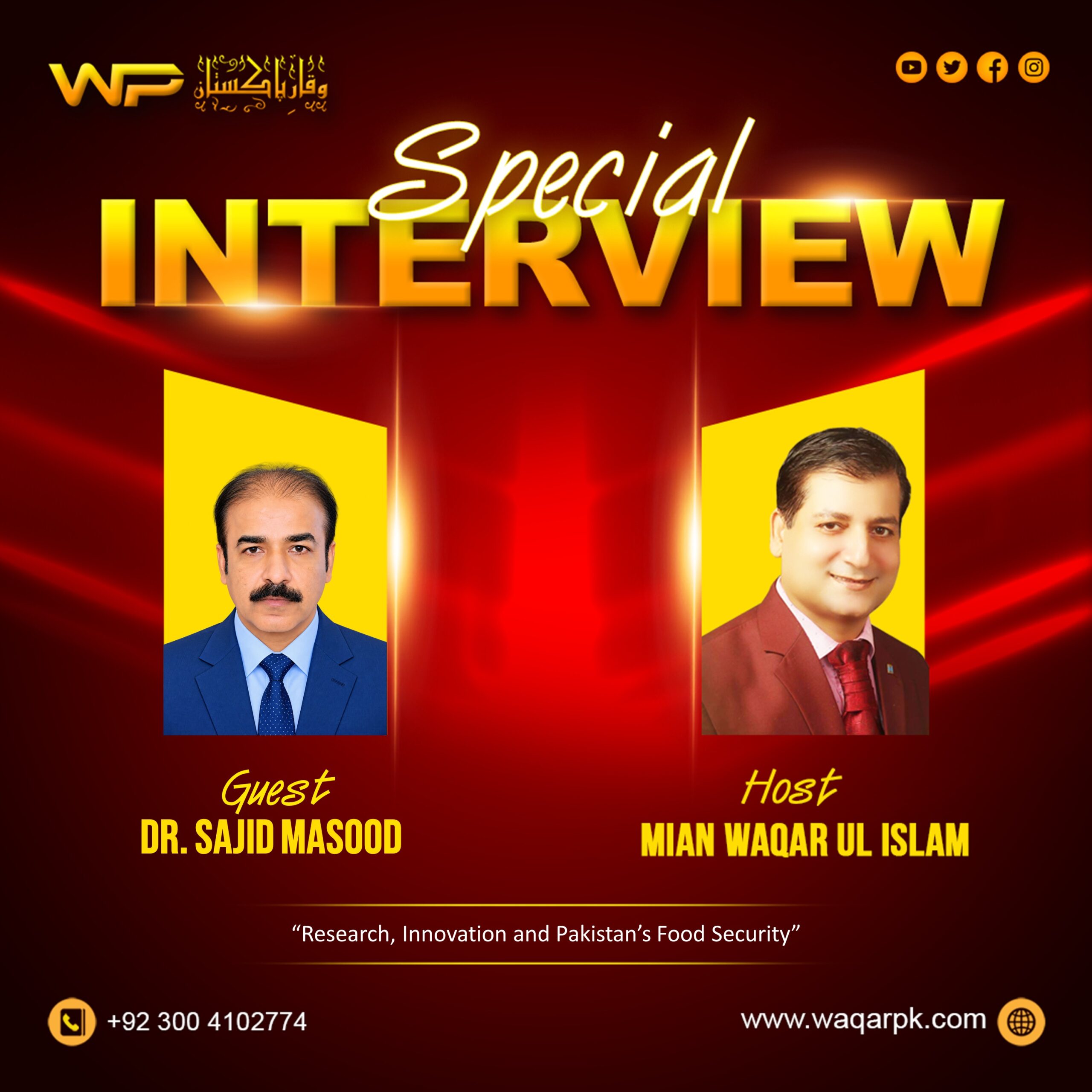
WAQAR-E-PAKISTAN | EXCLUSIVE INTERVIEW
Global Visionaries Interview Series
From Soil Science to Sustainable Agriculture: Research, Innovation and Pakistan’s Food Security
An Exclusive Interview with
Dr. Sajid Masood
PhD, Germany | Postdoctoral Researcher, China
Assistant Professor, Department of Soil Science
Faculty of Agricultural Sciences & Technology
Bahauddin Zakariya University, Multan, Pakistan
Interviewed by
Mian Waqar ul Islam
Founder & Author
Waqar-e-Pakistan – Literary Research Cloud
www.waqarpk.com
—
INTRODUCTION
Agriculture is more than an economic activity; it is the foundation of food security, rural livelihoods and national resilience. In a country like Pakistan, where agricultural productivity is closely connected with soil health, water availability, fertilizer efficiency and climate variability, scientific research has a critical role in shaping the future of sustainable development.
Dr. Sajid Masood is a Pakistani soil scientist and academic whose professional journey brings together international research, university teaching, agricultural industry experience and scientific innovation. He earned his PhD in Plant Nutrition and Soil Science from Christian-Albrechts University Kiel, Germany, in 2012, and subsequently undertook postdoctoral research at the Institute of Soil Science, Chinese Academy of Sciences, Nanjing, China, from 2015 to 2017.
Currently serving as an Assistant Professor at Bahauddin Zakariya University, Multan, Dr. Masood specializes in integrated plant nutrient management, soil salinity, plant nutrition, plant growth-promoting rhizobacteria, fertilizer development and sustainable agricultural practices.
His research has explored the interaction of salinity and boron toxicity in wheat, the role of beneficial microorganisms in plant nutrition, and approaches to improving nutrient-use efficiency. His work also extends to the development of agricultural products using organic and industrial waste materials, including NP Khas, Nitros Plus, soil conditioners and compost. Patent applications concerning NP Khas fertilizer and an activated-carbon-based soil conditioner have been submitted to Pakistan’s Intellectual Property Organization.
Beyond academic research, Dr. Masood has worked in the fertilizer industry, contributed to laboratory quality management, supervised postgraduate researchers and participated in international scientific publishing. His experience provides an opportunity to examine how research can be translated into practical solutions for farmers, agricultural enterprises and policymakers.
In this exclusive interview, Waqar-e-Pakistan explores his scientific journey, international exposure, research philosophy, agricultural innovations and vision for a more productive, resource-efficient and food-secure Pakistan.
—
INTERVIEW CONTENT
1. PERSONAL JOURNEY & SCIENTIFIC INSPIRATION
Question 1: Dr. Masood, every scientific journey begins with curiosity, an intellectual influence or a desire to solve a problem. What inspired you to pursue Soil Science and Plant Nutrition, and how did your academic journey lead you from the University of Agriculture Faisalabad to doctoral research in Germany and postdoctoral work in China?
Looking back at your early education, university experience and international research career, which experiences most significantly shaped your professional outlook and commitment to agricultural science?
2. INTERNATIONAL RESEARCH & GLOBAL EXPOSURE
Question 2: You completed your PhD at Christian-Albrechts University Kiel, Germany, and subsequently conducted postdoctoral research at the Chinese Academy of Sciences in Nanjing. How did these international experiences influence your scientific thinking, research methodology and approach to innovation?
What lessons from the German and Chinese research environments could help Pakistani universities strengthen laboratory facilities, scientific collaboration, research funding and the practical application of agricultural discoveries?
3. SOIL HEALTH, SALINITY & CROP PRODUCTIVITY
Question 3: Your doctoral research examined the interaction between salt stress and boron toxicity in wheat. Why is understanding the relationship between soil salinity, micronutrient balance and plant physiology important for Pakistan’s agricultural future?
How can farmers and agricultural specialists identify the underlying causes of declining crop performance, and what role can soil testing, appropriate crop selection and scientifically guided nutrient management play in addressing these challenges?
4. INTEGRATED PLANT NUTRIENT MANAGEMENT
Question 4: You have extensive experience in Integrated Plant Nutrient Management (IPNM). How can the balanced use of chemical fertilizers, organic amendments and beneficial microorganisms improve nutrient-use efficiency while maintaining long-term soil productivity?
In your view, what prevents the widespread adoption of evidence-based fertilizer recommendations in Pakistan, and how can universities, fertilizer manufacturers, extension services and farmers work together to bridge this gap?
5. BENEFICIAL MICROORGANISMS & BIOFERTILIZERS
Question 5: Your research has explored plant growth-promoting rhizobacteria (PGPR) and their potential role in improving plant nutrition and stress tolerance. How do these beneficial microorganisms interact with plant roots, and what opportunities do they offer for sustainable crop production?
What scientific validation, quality-control procedures and field trials are necessary before microbial products can be recommended reliably to farmers at a commercial scale?
6. AGRICULTURAL INNOVATION & WASTE VALORIZATION
Question 6: An important aspect of your work involves converting organic and industrial waste materials into potentially useful agricultural products, including NP Khas, Nitros Plus, soil conditioners and compost. What scientific principles guided these development efforts?
How can waste valorization contribute to resource efficiency, responsible waste management and the development of locally produced agricultural inputs? What evidence is required to establish the agronomic performance, safety and economic feasibility of such products under different soil and crop conditions?
7. PATENTS, RESEARCH COMMERCIALIZATION & INDUSTRY COLLABORATION
Question 7: Your CV records patent applications for NP Khas fertilizer and an activated-carbon-based soil conditioner. What does the process of transforming a research concept into a potential commercial product involve, and what challenges do Pakistani scientists face in protecting and commercializing their intellectual property?
How can universities, public research institutions, fertilizer companies and private investors establish stronger partnerships so that promising discoveries move beyond academic publications and undergo the testing, validation and development needed for practical use?
8. LABORATORY STANDARDS & SCIENTIFIC QUALITY
Question 8: During your professional career at Fatima Fertilizer Company Limited, you contributed to soil and water testing laboratory operations and quality-management systems. How important are standardized analytical procedures, equipment calibration and laboratory accreditation in ensuring the reliability of agricultural recommendations?
What improvements are needed to make dependable soil and irrigation-water testing more accessible and affordable for Pakistani farmers, particularly smallholders who must make fertilizer and crop-management decisions with limited resources?
9. CLIMATE CHANGE & THE FUTURE OF PAKISTANI AGRICULTURE
Question 9: Your research portfolio includes work on cotton genotypes, boron dynamics and agricultural productivity under changing climatic conditions. How should Pakistan adapt its agricultural research and farming practices to changing temperatures, water constraints, soil degradation and nutrient imbalances?
Which areas deserve greater national research attention: climate-resilient crop varieties, efficient irrigation, improved soil organic matter, biological nutrient management, precision agriculture or the development of locally adapted agricultural technologies? How should these priorities be balanced?
10. RESEARCH LEADERSHIP & THE NEXT GENERATION
Question 10: You have contributed to scientific publications, postgraduate supervision and international scholarly activities, including guest-editing responsibilities for Frontiers in Plant Science. What qualities distinguish a productive researcher, and how can Pakistani universities encourage students to pursue original, internationally relevant scientific work?
What practical advice would you offer young researchers regarding experimental design, data analysis, scientific writing, international collaboration and the responsibility to connect research with the needs of society?
11. A NATIONAL VISION FOR FOOD SECURITY
Question 11: Pakistan’s food security depends not only on increasing crop production but also on conserving natural resources, reducing avoidable input losses and improving the resilience of agricultural systems. What long-term strategy would you recommend for building a more sustainable and productive agricultural sector?
What three priorities should receive particular attention from government institutions, universities, agricultural industries and policymakers over the coming decade to strengthen soil health, water management, research capacity and farmers’ economic prospects?
12. PERSONAL PHILOSOPHY & MESSAGE TO PAKISTAN
Question 12: Finally, what message would you like to share with Pakistan’s farmers, agricultural students, researchers and policymakers?
As a scientist working at the intersection of research, education and practical agricultural challenges, what responsibility do you believe the scientific community carries toward future generations, and what gives you the greatest hope for the future of Pakistani agriculture?
—
CLOSING REMARKS
Dr. Sajid Masood’s professional journey brings attention to an essential dimension of national development: the relationship between scientific knowledge and the responsible management of natural resources.
Soil health, balanced plant nutrition, efficient water use, beneficial microorganisms and the development of locally relevant agricultural technologies are important areas of inquiry for a country whose prosperity is closely connected with agriculture. Research in these fields can help identify practical opportunities for improving productivity, conserving resources and strengthening the foundations of food security.
The broader challenge is to create stronger connections between universities, research laboratories, industry, policymakers and farming communities. Scientific discoveries must be rigorously tested, communicated clearly and evaluated under real agricultural conditions before their benefits can be established for wider adoption.
Through this special interview, Waqar-e-Pakistan seeks to document the experiences, ideas and contributions of Pakistani scholars whose work engages with important national and international challenges. Dr. Masood’s research career offers a valuable starting point for a deeper conversation about agricultural science, innovation and the future of sustainable development in Pakistan.
We look forward to sharing his responses and insights with our readers.
—
ABOUT THE INTERVIEWER
Mian Waqar ul Islam
Founder & Author, Waqar-e-Pakistan – Literary Research Cloud
Mian Waqar ul Islam is a consultant, researcher, writer and digital knowledge advocate whose work brings together literature, research, professional knowledge and digital engagement. Through Waqar-e-Pakistan, he has worked to preserve and promote the intellectual contributions of writers, researchers, educators, professionals and distinguished individuals.
His editorial approach emphasizes documenting personal journeys, professional achievements, intellectual contributions and ideas that can inform and inspire future generations.
Website: www.waqarpk.com
—
ABOUT WAQAR-E-PAKISTAN
Waqar-e-Pakistan – Literary Research Cloud
Preserving the Heritage, Knowledge & Legacy of Pakistan.
Founded by Mian Waqar ul Islam, Waqar-e-Pakistan is a digital platform dedicated to literature, research, knowledge preservation and the documentation of distinguished individuals and their contributions.
Through its interviews, knowledge series, biographies, literary collections and digital publications, the platform seeks to connect generations of writers, scholars, researchers, educators and professionals while preserving their intellectual and professional legacies.
Waqar-e-Pakistan — Preserving the Heritage, Knowledge & Legacy of Pakistan.
Visit: www.waqarpk.com