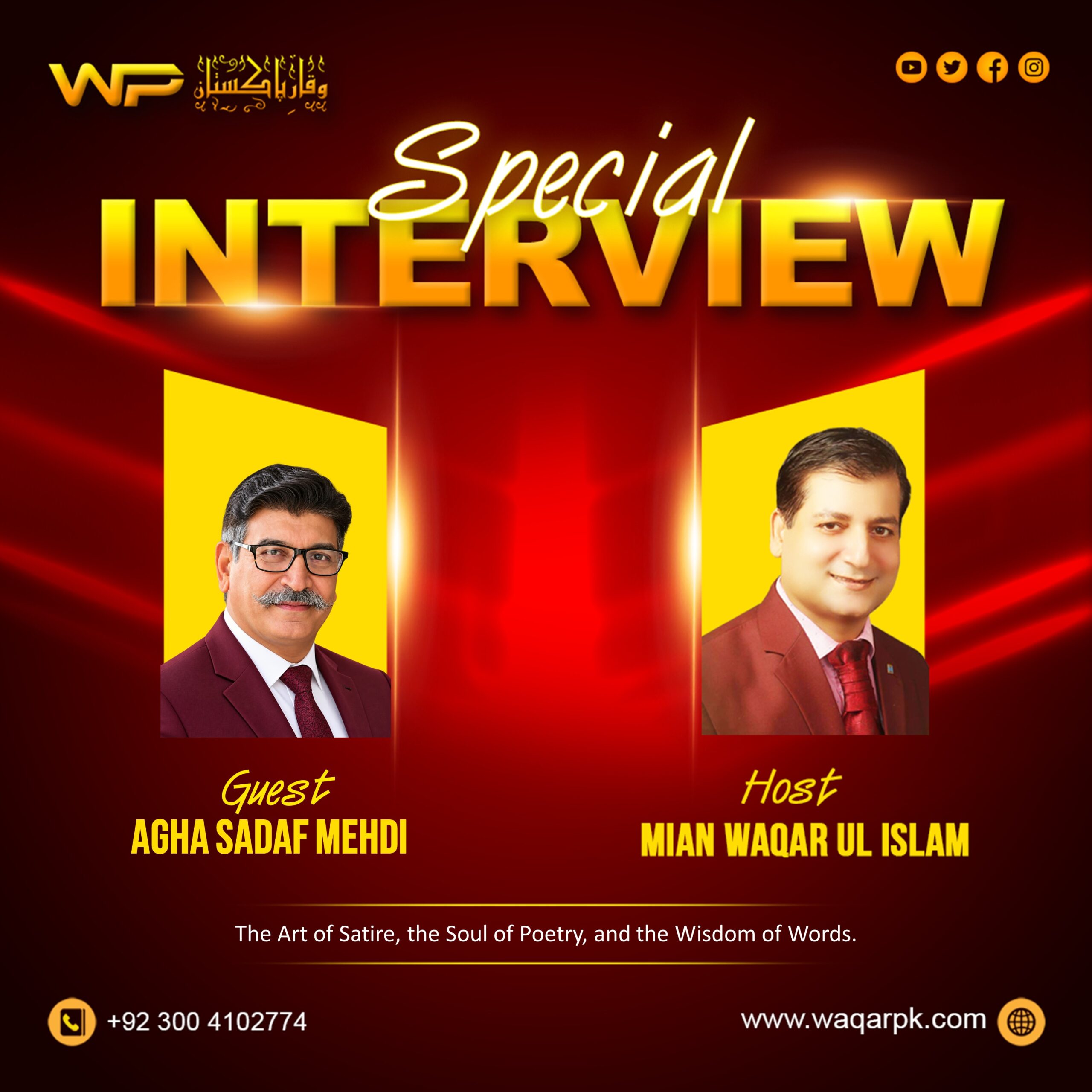
Agha Sadaf Mehdi: A Journey Through Literature, Theatre, Broadcasting and the Performing Arts
An Exclusive Literary Interview for Waqar-e-Pakistan
www.waqarpk.com
Poet | Story Writer | Playwright | Broadcaster | Painter | Sculptor | Theatre Director
Interview by Mian Waqar ul Islam
Introduction
Agha Sadaf Mehdi is a multifaceted Pakistani creative professional whose work spans poetry, storytelling, drama, broadcasting, painting, sculpture and theatre. His professional journey reflects a connection with literary expression, performing arts, cultural activities and educational institutions.
He has served as Senior Producer at Campus Radio FM 92.6 and as an advisor to the Islamia University Bahawalpur Performing Arts Society. He has also served as In-Charge of the Department of Fine Arts at Islamia University Bahawalpur and is associated with Theatre 21, Bahawalpur, as its director.
His professional experience includes hosting high-profile live programmes, national and international conferences, award ceremonies and official events. He has also contributed to theatrical productions staged in different Pakistani cities. His reported recognitions include awards for stage makeup, theatre direction, acting, drama writing and radio documentary work.
In this conversation with Waqar-e-Pakistan, Agha Sadaf Mehdi reflects on the relationship between literature and theatre, the importance of broadcasting, the role of arts education, and the preservation of Pakistan’s cultural heritage.
Interview
Question 1: You are associated with several creative fields, including poetry, storytelling, drama, painting and sculpture. How do you view the relationship between these different forms of artistic expression?
Agha Sadaf Mehdi: Poetry, storytelling, drama and visual arts provide different ways of expressing human emotions, experiences and ideas. Each form has its own language and method of communication. Poetry uses words and imagery, theatre brings characters and situations to life, while painting and sculpture communicate through visual form. These different disciplines can complement one another and contribute to a broader understanding of human experience.
Question 2: You have worked in broadcasting, theatre and cultural activities. What inspired your interest in these fields?
Agha Sadaf Mehdi: My professional journey has involved different forms of creative communication. Broadcasting offers an opportunity to connect with audiences through voice and ideas, while theatre allows stories and characters to be presented through live performance. Cultural activities bring people together around shared artistic experiences. Each field offers different possibilities for communication and creative expression.
Question 3: You have been associated with Campus Radio FM 92.6 at Islamia University Bahawalpur. What role can campus radio play in the intellectual and cultural development of students?
Agha Sadaf Mehdi: Campus radio can provide students with opportunities to develop communication skills, explore ideas and participate in educational and cultural discussions. It can serve as a platform for student voices, literary programmes, interviews, music and discussions on social issues. Such activities can help students develop confidence and become more actively engaged with their educational environment.
Question 4: You have also served as an advisor to the Islamia University Bahawalpur Performing Arts Society. How can universities encourage young people to participate in theatre and the performing arts?
Agha Sadaf Mehdi: Universities can encourage participation by providing opportunities for students to write, act, direct and work behind the scenes. Theatre requires teamwork, discipline, imagination and communication. When students participate in productions and cultural activities, they can develop practical skills and learn to collaborate with people who have different abilities and perspectives.
Question 5: You have served as In-Charge of the Department of Fine Arts at Islamia University Bahawalpur. What should be the primary objective of fine arts education in Pakistan?
Agha Sadaf Mehdi: Fine arts education should develop creativity, observation, technical ability and an understanding of artistic traditions. It should also encourage students to explore new ideas and express their perspectives through different mediums. Educational institutions can help students appreciate art not only as a personal pursuit but also as an important part of cultural and intellectual life.
Question 6: You have worked as a theatre director, actor and drama writer. What makes a theatrical production memorable and meaningful for its audience?
Agha Sadaf Mehdi: A meaningful theatrical production depends on several elements, including the strength of the story, the quality of the dialogue, the development of characters, acting and direction. Stage design, lighting, costumes and makeup also contribute to the overall presentation. When these elements work together effectively, a performance can engage audiences and encourage them to reflect on the ideas being presented.
Question 7: Your dramas, including Murad Manzil, Ke Pagal, Aik Or Tamasha Gar, Chehra, Band Gali and Soldier Never Dies, have reportedly been staged in different cities. What subjects or themes do you believe Pakistani theatre should explore?
Agha Sadaf Mehdi: Theatre can explore a wide range of subjects, including human relationships, social realities, cultural traditions and the challenges faced by individuals and communities. Pakistani theatre has the opportunity to present stories drawn from everyday life while also exploring historical and contemporary experiences. The choice of subject should be supported by thoughtful writing and an understanding of the audience.
Question 8: You have hosted numerous high-profile events, including conferences, award ceremonies and official programmes. What qualities are essential for a successful compere or presenter?
Agha Sadaf Mehdi: A successful presenter needs confidence, preparation, clear communication and the ability to understand the nature of an event. The presenter must respect the programme, its participants and its audience. Timing, appropriate language and the ability to respond calmly to unexpected situations are also important. Good presentation is not merely about speaking well; it is about helping an event proceed smoothly and communicating its purpose effectively.
Question 9: You have received recognition for stage makeup and theatre-related work. How important are makeup, costumes and visual presentation in bringing a theatrical character to life?
Agha Sadaf Mehdi: Makeup and costumes help communicate aspects of a character’s appearance, personality, age and circumstances. They also contribute to the visual identity of a production. These elements must support the story and the director’s interpretation rather than distract from the performance. Their effectiveness depends on how well they work with acting, lighting, stage design and the overall concept of the production.
Question 10: You have received recognition for your work in broadcasting and theatre. What do such awards mean to an artist, and how should artists respond to recognition?
Agha Sadaf Mehdi: Recognition can be encouraging because it acknowledges effort, skill and commitment. However, an artist’s development should remain a continuous process. Awards can provide motivation, but they should also encourage further learning, experimentation and improvement. The lasting value of creative work lies in its quality, its contribution to the field and its ability to connect with people.
Question 11: In the age of social media, digital broadcasting and artificial intelligence, how can traditional theatre, radio and literature remain relevant to younger generations?
Agha Sadaf Mehdi: Digital technology provides new opportunities to share creative work with wider audiences. Radio programmes, interviews, theatrical performances and literary discussions can be recorded, preserved and made accessible through online platforms. At the same time, traditional art forms retain their value because of their distinctive methods of expression and their connection with human experience. The challenge is to use new technologies to extend their reach while maintaining the quality and authenticity of the content.
Question 12: What steps should Pakistan take to preserve its theatrical history, literary heritage, radio recordings and the contributions of artists?
Agha Sadaf Mehdi: Preserving cultural heritage requires documentation, research and cooperation among artists, educational institutions, cultural organisations and archives. Historical recordings, scripts, photographs, interviews and production records can be preserved digitally and made accessible to researchers and students. Recording the experiences of senior artists is also important because their personal histories can provide valuable insights into the development of Pakistan’s cultural life.
Question 13: What advice would you offer to young people who wish to become actors, playwrights, broadcasters, painters or theatre directors?
Agha Sadaf Mehdi: Young people should develop their skills through study, observation, practice and participation in practical projects. They should learn from experienced professionals, remain open to constructive criticism and understand the responsibilities associated with creative work. Talent is important, but discipline, patience, collaboration and continuous learning are equally valuable in building a sustainable career in the arts.
Question 14: Finally, what would you like readers of Waqar-e-Pakistan to understand about the importance of literature and the performing arts in society?
Agha Sadaf Mehdi: Literature and the performing arts provide ways to understand people, experiences and social realities. They can preserve cultural traditions, encourage reflection and create opportunities for dialogue between different generations. Supporting writers, performers, broadcasters and artists is therefore an important part of preserving a society’s cultural identity and encouraging future creative development.
Closing Note
Agha Sadaf Mehdi’s professional journey brings together literature, broadcasting, theatre, fine arts and cultural activities. His reported work with Campus Radio FM 92.6, the Performing Arts Society at Islamia University Bahawalpur, university fine arts administration and theatrical productions reflects the diverse professional settings in which creative expression can develop.
His experience as a presenter, theatre practitioner and arts professional provides a valuable starting point for documenting the role of creative individuals in Pakistan’s cultural landscape. His journey also highlights the importance of arts education, cultural documentation and opportunities for younger generations to engage with literature and the performing arts.
Waqar-e-Pakistan continues its commitment to documenting literary journeys, preserving personal histories and bringing the experiences of writers, researchers, broadcasters and creative personalities to readers and researchers. Through this interview series, we aim to create a lasting record of the people and experiences that contribute to Pakistan’s intellectual and cultural heritage.
Interview by Mian Waqar ul Islam
Waqar-e-Pakistan Literary Research Cloud
www.waqarpk.com